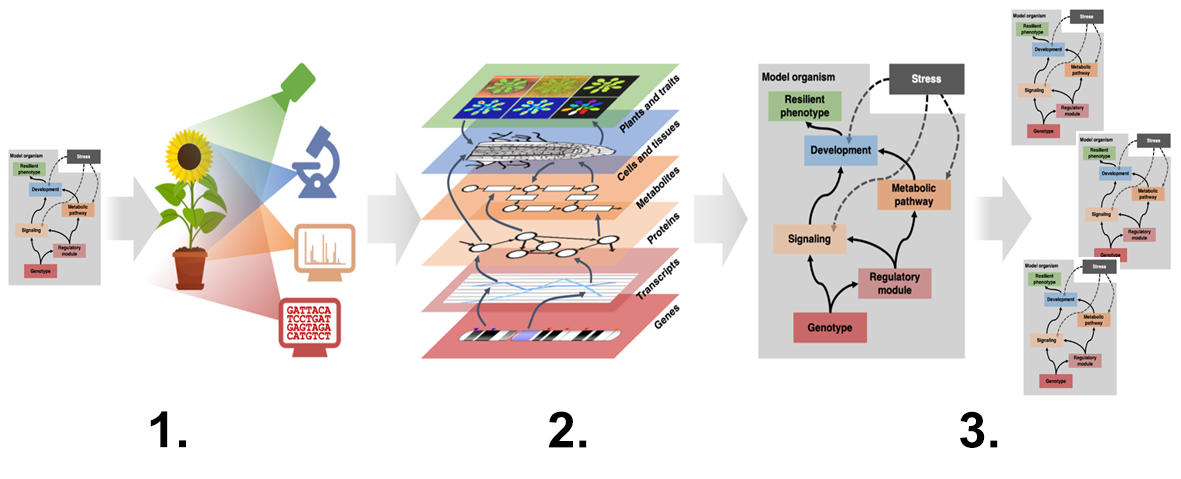

We develop a smart data methodology to
accelerate breeding for resilience

For this methodology, we combine biological experiments and large data sets with advanced computational modelling and artificial intelligence to transform how breeders improve crops. We develop smart data building blocks that will enable breeders to more rapidly develop actual products and bring them to the market sooner.

Our approach

Biotechnology line icon set. Group of object, gmo, biochemistry, bioengineering, genetic modification, dna, science, chemistry.

Learning from thousands
of Arabidopsis plants

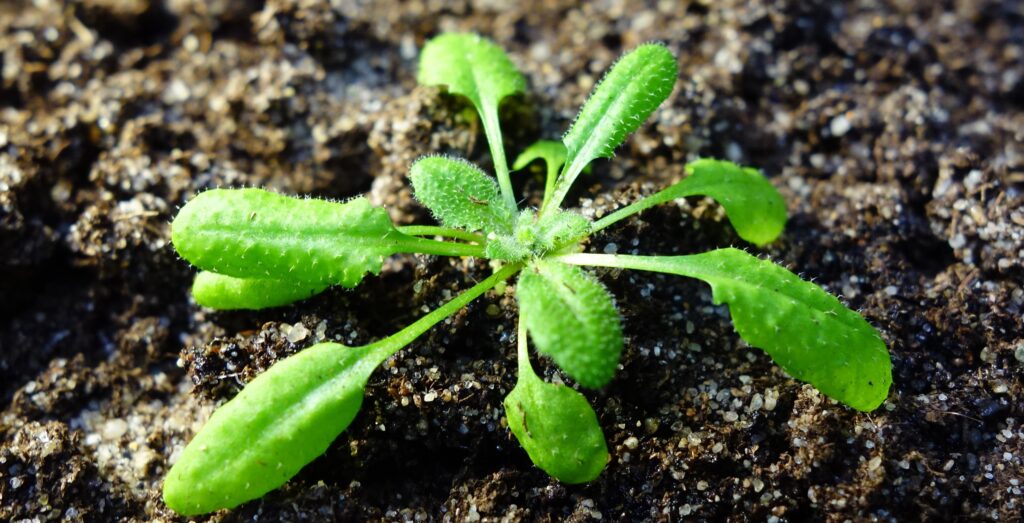
In our laboratories, we work with Arabidopsis Thaliana. Using existing data, we first develop hypothesis-driven models that guide targeted experiments. These studies generate large datasets showing how resilience emerges under stress, which we integrate into models outlining Arabidopsis’ key resilience traits.

Biotechnology line icon set. Group of object, gmo, biochemistry, bioengineering, genetic modification, dna, science, chemistry.

Turning experimental data
into models

Based on this outline, we use AI and Mechanistic Modelling, to combine the experimental data into models that yield new insights into the key regulators of plant resilience.

Translation from model plant
to food crop

By starting from an understanding of underlying mechanisms rather than purely statistical patterns, we can adapt our models to other crops using far less crop-specific data. Instead of rebuilding knowledge for each species, we recalibrate existing models to reflect crop-specific traits.

The interplay between lab experimentation and model formulation is
an ongoing iterative process

The interplay between model formulation and translation to food crop
is also an iterative process

The Smart Data Technology

Three phases

Experimental research & data collection

Researchers carry out hypothesis-driven experiments in plants, initially using Arabidopsis as a model organism.

These experiments generate vast amounts of high-quality data on how plants respond to environmental stressors like drought, heat, salinity, pathogens and more.

Data integration and modelling

The collected data are integrated and processed using artificial intelligence and mechanistic modelling

This produces mechanistic plant models that capture how resilience arises.

Smart Prediction of Resilience Traits

These models allow scientists to predict which genetic combinations and traits contribute to resilience under diverse stresses.

Instead of relying solely on traditional breeding (which can be slow), these insights help breeders target key traits more effectively.

Modelling Arabidopsis

CropXR expects to be able to model Arabidopsis in the next couple of years, leading to a more refined model after approximately five years. Subsequently, these models can be translated to specific crops.

When this phase arrives, significantly less crop-specific data will be needed. This will enable adaptation to so-called ‘spin-off’ models for other crops. Breeders can then use these models to step up their game.

Further Reading

Resilience Hub

The Resilience Hub or data infrastructure of CropXR is built to store and share all the data generated and used for the CropXR research. In the coming years, the Resilience Hub will further evolve into a central place where all those working in the field of crop resilience can retrieve valuable information. In due time, the software packages that implement the models will be made available in open repositories.

Central office: management, support and communication

A Central Office manages, supports, and interconnects the various compartments and programs of the institute. Internal communication is supported. Moreover, external communication is maintained through effective public relations with the world at large.

Education

The knowledge of professionals working in the realm of plant research, breeding, data sciences and agriculture, or those aspiring to do so, needs to be on a par with the developments that CropXR accelerates. In collaboration with institutes in the field of ‘green education’ the Education program of CropXR develops and updates curricula at academic universities and universities of applied sciences in the Netherlands. Moreover, by bringing together students, scientists and professionals of industrial companies, knowledge is shared, and unique synergies arise. The work of Education equips professionals with relevant knowledge to bridge a broad spectrum of plant sciences and data, AI and modelling disciplines and social sciences.  

Research

With its Research, CropXR works to better understand resilience of plants against multiple (and combined) stresses. These include drought, heat, flooding, salinisation, soil degradation, pests, and diseases. The institute uses these insights to develop an innovative smart data breeding technology, creating more resilient varieties of various plant or crops. As crops are cultivated plants grown on a large scale for consumption or other commercial purposes, the impact of this innovation will affect many. CropXR is keen to positively impact society. It studies, therefore, crop resilience through different societal lenses. Stakeholders or groups in society such as, for example, breeders, farmers, policymakers or consumers can perceive crop resilience in a different way. Their opinions can vary greatly. This is why it is important to understand all possible perspectives and take them into account when developing the smart data breeding technology. In addition, CropXR recognises that cultivation methods, or the way crops are grown in the field, can enhance the effectiveness of more resilient crops. By studying breeding for resilient cropping systems, CropXR wants to contribute to a practical application of the knowledge it yields. The study of new cultivation methods and its practice in the field, is another important element of the research.

Crop Resilience

CropXR works on Crop Resilience on a selected number of crops in the next decade. The smart data breeding technology that is being developed will be deployed to practical breeding tools for those crops, which are tomato, lettuce, onion, brassica, cauliflower (another brassica), potato and chrysanthemum. The industrial partners of CropXR have profound knowledge of these crops. In addition, the crops are cultivated in many places around the world and offer high nutritional value. The potato, for instance, feeds millions of people. Whereas chrysanthemum is the most important ornamental plant in the Netherlands. Once the methodology is solid and yields good results, more crops can be added to the selection. After ten years, the expectation is that many more crops can benefit from the smart data breeding concept.

Knowledge Transfer

CropXR collaborates with companies and other institutions both in the Netherlands and worldwide to spawn new basic and translational research projects. These collaborations contribute to finetuning the insights and innovations CropXR develops. Moreover, they enable breeders and growers to deploy the smart data breeding technology and expand it to crops that are outside the scope of CropXR. New initiatives are developed to enhance international impact and knowledge transfer.

Breeding

CropXR aims to take the smart data breeding technology to the next level. The institute, therefore, aims to support entrepreneurial activities that contribute to a widespread uptake of the smart data technology. Related activities, ensuing from the knowledge and expertise CropXR gains, will be embraced and supported.

Actors operating in the realm of the activities of CropXR are, therefore, encouraged to engage and tap into the generated knowledge. CropXR envisions that those actors will deploy the smart data breeding technology to a wide range of crops for different climate regions. By initiating or fueling such activities, CropXR hopes to be a driving force. This will enable CropXR partners or other actors to develop new applications, whilst utilizing the rich knowledge of the CropXR network.

In this phase, CropXR regularly presents its findings at national and international meetings to the breeding sector and constantly makes new connections. CropXR and its surrounding network will be able to swiftly move to product development once this phase arrives.

Impact

CropXR aims to have positive impact with all its activities. These activities span a wide array of fields. They range from conducting (fundamental) research, developing tools and methodologies, education and societal and economic activities. All these elements together have a ripple effect that leads to change and societal impact.

Resilience Hub Central Office Education CropXR Institute Our team Research Breeding Impact Crop Resilience Knowledge Transfer